
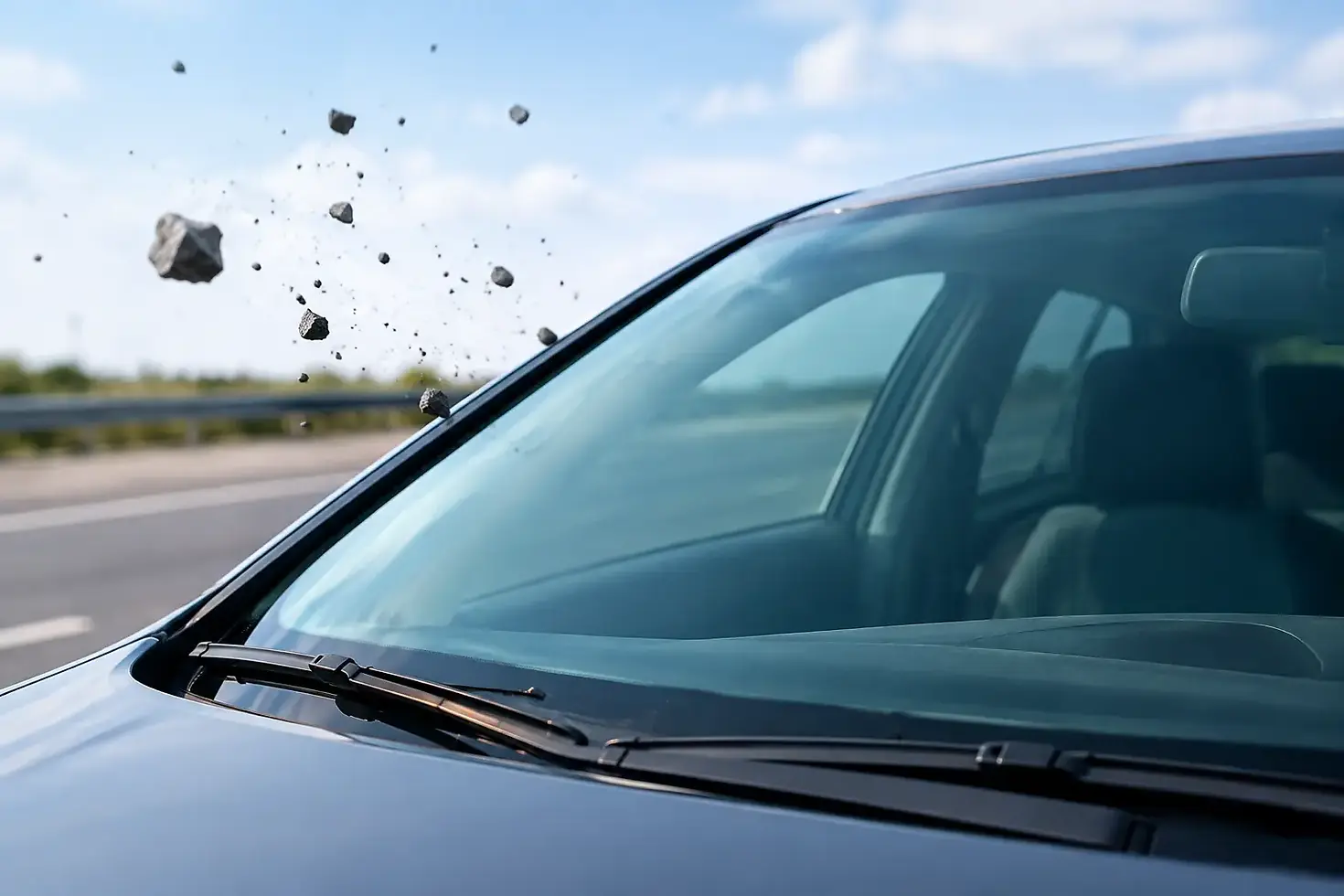
How to Avoid Road Debris Damage to Your Windscreen
A loose stone flicked up by the vehicle in front can leave a windscreen chip in a split second. You cannot avoid road debris damage entirely, especially on busy motorways, rural routes and roads with ongoing works, but a few sensible habits can greatly reduce the risk. Just as importantly, knowing what to do when a chip appears can stop a small mark becoming a cracked windscreen and a much bigger job.
Why road debris damages windscreens
Most windscreen chips are caused by stones, grit or pieces of loose road surface being thrown backwards by tyres. Lorries, vans, farm vehicles and cars travelling quickly on loose chippings can all send debris towards the vehicle behind.
The impact point may be tiny, but modern windscreens are made from two layers of glass with a plastic layer between them. A sharp impact can break the outer glass and create a bullseye, star, petal, half-moon or small crack. Left alone, vibration, cold weather and changes in temperature can make that damage spread.
This is why a chip that looks no bigger than a pinhead after your commute should not be ignored. The best time to deal with it is before dirt and moisture work their way into the break, and before the glass has a chance to move.
Keep a proper gap from the vehicle ahead
The simplest way to avoid road debris damage is to leave more space than feels strictly necessary. Tailgating puts your windscreen directly in the firing line of stones thrown up by the vehicle ahead. It also gives you less time to spot potholes, loose material and fallen items in the road.
Use at least the normal two-second gap in dry conditions, then increase it in rain, poor visibility or on roads that have been recently resurfaced. On a motorway, give extra room to vehicles with large tyres, lorries carrying aggregate, and anything travelling on an uneven hard shoulder or verge.
There is a trade-off here. Heavy traffic does not always allow a generous gap, and another car may move into it. That is fine. Ease back again when it is safe rather than trying to hold your position close behind the vehicle in front.
Be alert around roadworks and loose chippings
Freshly dressed roads, resurfacing works and temporary road repairs are high-risk areas for windscreen damage. Loose stones can remain on the carriageway for days or weeks, even when the work itself appears to be finished.
Slow down when you see loose chippings signs. Lower speed means tyres throw debris with less force, and it gives you more room to avoid visible patches of gravel. Avoid overtaking if doing so would mean driving through a strip of loose material, particularly on country roads where the surface is narrow and uneven.
Roadworks also create other risks. Mud from site vehicles, fragments of broken tarmac and unsecured material can all be present. Keep well back from construction vehicles and do not assume a clean-looking lane is free from grit.
Choose your position carefully, without overcorrecting
On dual carriageways and motorways, debris often collects near lane edges, around slip roads and close to the central reservation. Where traffic conditions allow, avoid driving through obvious gravel, broken plastic or scattered load material.
Do not swerve sharply to miss a small object. A sudden movement may create a greater risk for you, your passengers and other road users. If something appears too late to avoid safely, reduce speed smoothly, keep both hands on the wheel and drive through it with control.
The same applies to potholes. A pothole can contain loose stones, and hitting it hard can also place stress on the windscreen. Slow down where possible, especially after rain when standing water can hide damage to the road surface.
Think twice before following certain vehicles
You will not always be able to choose who is in front of you, but you can recognise situations where it pays to hang back. Vehicles coming off building sites, agricultural machinery, tippers and lorries carrying loose materials deserve extra space. So do vehicles with visibly muddy tyres, because those tyres may drop stones and dirt as they travel.
If a vehicle has an uncovered or poorly secured load, do not sit behind it hoping for the best. Change lanes when it is safe, increase the gap, or take a different route if the risk continues. A small detour is usually less trouble than a damaged windscreen.
Protect the glass from temperature stress
Road debris causes the initial impact, but temperature changes often turn a manageable chip into a crack. In winter, do not pour hot water over a frosty windscreen. The rapid change in temperature puts pressure on the glass, particularly around an existing chip.
Use a scraper and suitable de-icer instead. Likewise, avoid blasting very hot air directly at a cold damaged area as soon as you start the car. Let the screen warm gradually where you can.
In summer, a windscreen that has been baking in direct sunlight may also be under stress. There is no need to avoid using air conditioning, but avoid extreme temperature changes if you have just noticed a chip. Prompt repair is the sensible answer.
What to do straight after a stone hits your windscreen
A loud tap does not always mean obvious damage, so safely check the windscreen when you stop. Look from inside and outside the vehicle. A chip can be difficult to see in bright light, and it may look like a small white dot, a dark pit or a fine star shape.
If you find one, keep the area clean and dry. Do not pick at it, press on it or wash the car with high-pressure water over the damage. If you have a clear windscreen repair patch, place it over the chip to keep out moisture and dirt. A small piece of clean transparent tape can work as a short-term cover, provided the glass is dry and you do not press debris into the break.
Then arrange an assessment as soon as you can. A clear photo taken from outside the vehicle, with a coin nearby for scale, helps a trained technician judge whether the damage is likely to be repairable before visiting.
When a chip can usually be repaired
Many common chips can be repaired effectively when dealt with early. Bullseyes, half-moons, petal breaks, stars, cross-hair chips and small long cracks may all be suitable, depending on their size, position and condition.
There are limits. Damage at the edge of the windscreen, cracks larger than a £2 coin, heavily contaminated chips and damage directly in a critical driver viewing area may not be suitable for repair. A proper assessment matters because the aim is not simply to make the mark less visible. It is to restore strength to the damaged outer layer and help prevent the crack from spreading.
A professional repair injects specialist resin into the break under controlled pressure, then cures it to stabilise the glass. The chip normally becomes much less noticeable, although a repair is not a promise of invisible glass. On an older or dirty chip, a faint mark can remain even after a successful structural repair.
Do not wait for MOT time
Drivers often put off a chip because it does not seem urgent. Then a cold morning, a speed bump or a change in weather turns it into a long crack. At that point, repair may no longer be possible, and replacement becomes the only option.
For motorists across Hampshire, Surrey and Berkshire, a mobile chip repair specialist can normally deal with eligible damage at your home or workplace in around 20 to 30 minutes. Chip Repair UK uses professional Delta repair resin and can assess a photo by WhatsApp before you book, so you can get a straightforward answer without guessing.
Keeping your original windscreen is often the better outcome. It avoids the disruption of replacement, costs less where repair is suitable and creates less waste. It can also be particularly worthwhile for classic, prestige and high-performance vehicles where preserving factory-fitted glass is a priority.
The next time you hear that sharp ping on the road, do not wait to see whether it gets worse. Check the glass when it is safe, protect the chip from dirt and water, and get a clear assessment while a quick repair is still on the table.



Comments